🏟️ The Story of Real Madrid’s Iconic Stadium: From Past to Present

When people think of football greatness, they think of Real Madrid — and when they think of Real Madrid, one place comes to mind: the Santiago Bernabéu Stadium. But this legendary ground didn’t appear overnight. Its story is one of vision, passion, and constant evolution. Let’s take a journey through time and see how the home of Los Blancos became one of the most famous stadiums in the world.

⚽ The Early Beginnings (1912–1923)

Before Real Madrid became a global powerhouse, the team played at a small ground called Campo de O’Donnell. It could hold around 5,000 fans — no stands, no roof, just open air and pure football.
It was here that Real Madrid started to build its name and connect with the local fans of Madrid.

🏗️ The First Step Forward – Estadio Chamartín (1924–1946)

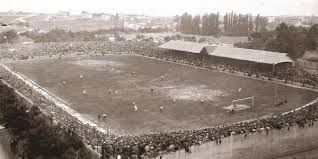
As Real Madrid grew, so did its dreams. In 1924, the club opened its first real stadium, the Estadio Chamartín, which could hold around 22,500 spectators.
The opening match was against Newcastle United, and Real Madrid won 3–2 — a perfect start to a new era.
This stadium saw the club rise to become one of Spain’s top sides. But soon, even Chamartín wasn’t big enough for what Real Madrid was becoming.

👑 The Vision of Santiago Bernabéu (1947–1955)

After World War II, Real Madrid’s president Santiago Bernabéu Yeste had a dream: to build a stadium that matched the club’s ambition.
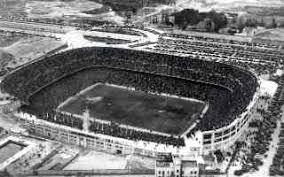
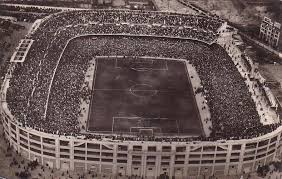
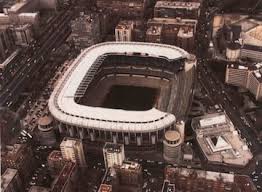
Construction began in 1944, and on December 14, 1947, the brand-new Estadio Chamartín opened with 75,000 seats. In 1955, it was renamed the Santiago Bernabéu Stadium, honoring the man who made it all possible.

From that moment, the Bernabéu became the beating heart of Real Madrid.

🌟 The Golden Era (1950s–1970s)

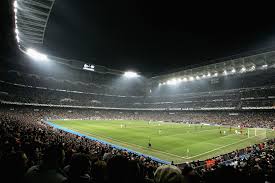
The 1950s brought Real Madrid’s rise to global fame — and the Bernabéu was the stage. Legends like Alfredo Di Stéfano, Ferenc Puskás, and Paco Gento turned this stadium into a fortress.
Real Madrid won five consecutive European Cups here, setting records that still echo through football history.

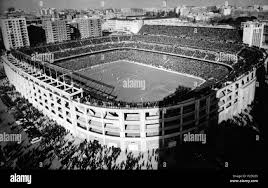
The stadium expanded several times, eventually holding more than 120,000 fans before all-seater rules arrived. Every match was a spectacle — pure football magic.

🌍 The 1982 World Cup Transformation

For the 1982 FIFA World Cup, Spain modernized the Bernabéu to host the world’s best.
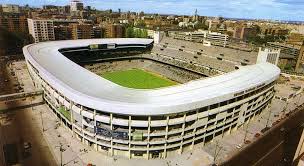
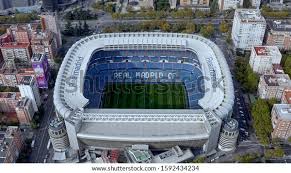
It got a fresh look — a new roof, improved facilities, and all seats instead of terraces (reducing capacity to about 90,000).
The Bernabéu even hosted the World Cup Final that year, where Italy beat West Germany 3–1.
It became not just a club stadium, but a world football landmark.

💫 The Modern Era (1990s–2000s)

In the late 20th century, the stadium continued to evolve. Under presidents like Florentino Pérez, new VIP areas, restaurants, and lighting systems were added.
By the early 2000s, fans could tour the stadium and visit the Real Madrid museum, home to dozens of glittering trophies.
This was the time of the Galácticos — Zidane, Ronaldo, Beckham, and Raúl — and the Bernabéu became the theater of dreams for a new generation.

🚀 The New Santiago Bernabéu (2019–Present)

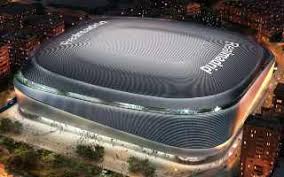
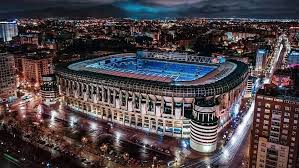
In 2019, Real Madrid began the biggest transformation in its history. Florentino Pérez unveiled plans for a futuristic Bernabéu — turning it into one of the most advanced stadiums on Earth.

Now complete in 2024, the new Santiago Bernabéu is breathtaking:

  • A retractable roof that closes in minutes

  • A 360° video scoreboard

  • A retractable pitch, allowing concerts and events

  • A stunning steel exterior with LED lighting

  • New restaurants, shops, and fan zones

  • Capacity for over 84,000 spectators

The renovation cost around €1 billion, but it made the Bernabéu more than a football ground — it’s now a global entertainment arena.

🏆 Iconic Moments & Legacy

From World Cup finals to unforgettable Champions League nights, the Bernabéu has seen it all. It has hosted:

  • The 1982 World Cup Final

  • The 1964 Euro Final

  • The 2010 Champions League Final
    And of course, countless El Clásicos between Real Madrid and Barcelona.

💖 The Heart of Real Madrid

Today, in 2025, the Santiago Bernabéu stands as a symbol of Real Madrid’s history, pride, and power. It’s where legends are made, dreams come true, and fans from around the world unite under one chant:

“¡Hala Madrid y nada más!” — Go Madrid, and nothing more.

🏟️ Who Gave the Name “Santiago Bernabéu Stadium”?

The famous name of Real Madrid’s home — Santiago Bernabéu Stadium — comes from one of the most legendary figures in the club’s history, Santiago Bernabéu Yeste.

He wasn’t just a club president; he was a former player, coach, and the visionary leader who completely transformed Real Madrid. When he took over as president in 1943, he dreamed of building a world-class stadium that matched the club’s ambitions. That dream came true in 1947, when the new ground opened under the name Nuevo Estadio Chamartín.

Years later, in 1955, the club decided to honor Bernabéu’s incredible contribution by renaming the stadium to Estadio Santiago Bernabéu. It was the perfect tribute to the man who turned Real Madrid into one of the greatest football clubs on the planet.

So, the name isn’t just a title — it’s a thank you to the man whose vision built Real Madrid’s home and legacy.

💬 In short: The stadium got its name from Santiago Bernabéu, the president who dreamed it, built it, and changed Real Madrid forever.
IF you guys want to know more about real mardid club you can click here 👇⬇️

1 thought on “Santiago Bernabéu Stadium”

  1. Pingback: Real madrid - pitchballer.com

Leave a Comment

Your email address will not be published. Required fields are marked *

Scroll to Top