
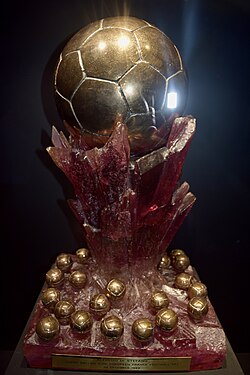
🏆 The Super Ballon d’Or: Football’s Rarest Honor
When we talk about football’s most prestigious individual awards, the Ballon d’Or is usually at the top of the list. But there’s one trophy that stands above even that — so rare, in fact, that it’s only ever been awarded once in the entire history of the sport.
It’s called the Super Ballon d’Or, and it’s almost mythical.
👑 The One and Only Winner
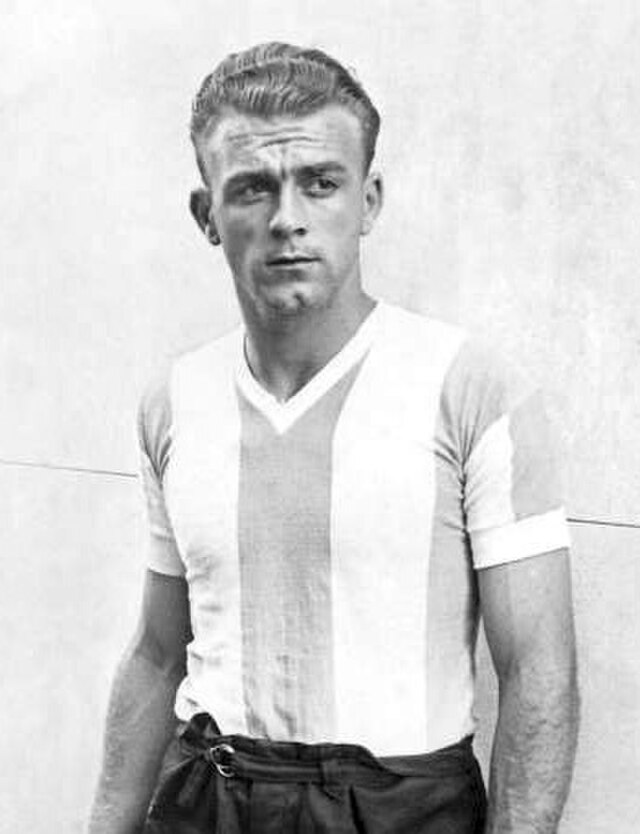
Back in 1989, French football magazine France Football — the same organization that created the Ballon d’Or — decided to do something special. To celebrate their 30th anniversary of the Ballon d’Or, they introduced a one-off award to recognize the greatest footballer of the past three decades.
That award went to Alfredo Di Stéfano.
For many younger fans, his name might not come up in the usual GOAT debates. But for those who watched him play — and those who truly understand football history — Di Stéfano was a revolutionary. He was the heartbeat of the Real Madrid team that dominated Europe in the 1950s, winning five consecutive European Cups (what we now call the Champions League).
He wasn’t just a goal scorer. Di Stéfano could do everything — attack, defend, create, lead. He was known for his intelligence, versatility, and unmatched work rate. And in 1989, decades after his prime, he was officially recognized as the best of the best.
Super Ballon d’Or Winner Di Stéfano full life history
Early Life & Beginning
Born: July 4, 1926, in Buenos Aires, Argentina.
His father, Alfredo Sr., was also a footballer; his mother was of French–Irish descent. He grew up in a working‑class district and played informal street football before joining youth sides.
He was Rise in Argentina
He started his senior career at River Plate in 1944.
In 1946 he was loaned to Huracán, then returned to River Plate.
In 1947, he won the Argentine Primera División with River Plate and was top scorer of the league with 27 goals. Also in 1947, played for Argentina in the South American Championship (Copa América), scoring 6 goals in 6 matches.
He was Move to Colombia (“El Dorado” Era)
In 1949, a strike in Argentinian football (along with other disruptions) led him to join Millonarios in Bogotá, Colombia — during a period when the Colombian league was not under strict FIFA control.
At Millonarios (1949–1953), he won several league titles (1949, 1951, 1952, 1953) and established himself as one of the finest forwards in South America. He was the league’s top scorer in 1951 and 1952.
He was Transfer to Real Madrid & European Greatness
In 1953 he transferred to Real Madrid, after a complicated negotiation (Barcelona had also wanted him).
At Real Madrid (1953‑1964), he would become one of the centrepieces At Real Madrid (1953‑1964), he would become one of the centrepieces of European football.
Achievements at Real Madrid
Domestic Success: He won 8 La Liga titles.
Spanish Cup (Copa del Rey): Won at least once in his time there.
European Cups: Five in a row (1956, 1957, 1958, 1959, 1960).
He scored in each of those five European Cup finals, which is extraordinary. For example, in the legendary 1960 final at Hampden Park, Madrid beat Eintracht Frankfurt 7‑3 — often seen as one of the greatest club matches ever. Di Stéfano had a hat‑trick in that one.
International Career
Di Stéfano’s international story is complicated by nationality, timing, and eligibility:
Argentina: He played for Argentina in 1947, including the Copa América which they won. But after moving abroad his chances with Argentina dwindled.
Colombia: During his time at Millonarios, he played in unofficial matches for Colombia. Since they were outside FIFA supervision in that period, many of those matches aren’t officially counted.
Spain: He became a Spanish citizen and played for the Spanish national team from roughly 1957 to 1961. He scored quite a few goals for Spain. However, he never got to play in a World Cup — partly because of injury and partly due to how the timing worked out.